What Campus Reviews Reveal
The public reviews for Inha University offer a mixed but largely positive picture — and the comments that mention the university’s atmosphere and location are especially relevant for someone choosing housing. One Google reviewer, who simply visited the campus, said: “I am not a student at this university but I stopped by for a visit and love the view here. Came here on weekend and during winter break so there was not that much students inside but the view is beautiful. You can get free parking inside if it is under 15 mins.” This suggests that the campus itself is visually pleasant and open to visitors, which can be a plus if you plan to spend study or leisure time on the grounds.
Another reviewer commented: “That’s really cool 대학교 for ones who are gonna study in South Korea. One of the most distinguished Universitys and at the same time the best one in terms of Engineering.” The emphasis on engineering is consistent with Inha’s reputation (founded as an aviation/engineering institution), and it implies that students in those programs may have concentrated schedules and lab hours — a factor that makes proximity to campus more valuable.
A negative review about the dental clinic on campus (rating 1 star) highlights that not every university service meets expectations, but it does not reflect on the overall student residential experience. The key takeaway for housing is that students generally see Inha as well-regarded and that the campus environment is appealing, encouraging a search for accommodation that minimises commute time.
City Context: Incheon for Students
Inha University is located in Michuhol-gu, Incheon, South Korea — the country’s third-largest city and a major port and transport hub. Incheon is often considered more affordable than Seoul while still offering excellent connectivity. The university sits near the Incheon Subway Line 1 (Inha University Station is a short walk from the main gate), making it straightforward to travel to other parts of the city or to Seoul (roughly 40–60 minutes by subway/express bus).
For international students, Incheon International Airport is only about 30 minutes away by public transport, which is convenient for arrivals and departures. The area around the university has a mix of commercial streets, restaurants, convenience stores, and small parks. Because Inha was established in 1954, the neighbourhood has matured around the campus, with many purpose-built student housing options and shared flats within walking distance.
Living costs in Incheon tend to be 15–25% lower than in central Seoul, especially for rent and groceries. However, prices can vary depending on how close you are to the campus gate. The local currency is the South Korean won (KRW). All figures below are indicative — confirm with the operator before making any commitment.
Budget Bands for 2026/2027
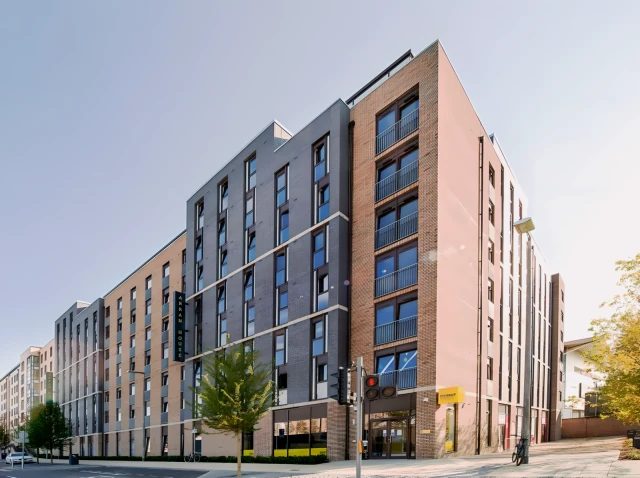
For the 2026–2027 academic year, monthly rent ranges (indicative — confirm with the operator) for typical student housing options near Inha University are as follows:
- Goshiwon (study room-style): A very basic furnished room with a shared bathroom and often a shared kitchen. Monthly rent: 250,000–400,000 KRW (approx. USD 180–290). These are the cheapest options, but space is tiny (usually 5–8 ㎡) and noise can be an issue. Suitable for students who spend most of the day on campus or in the library.
- One-room (officetel style): A small self-contained studio with private bathroom, a kitchenette, and often a small balcony. Monthly rent: 400,000–700,000 KRW (approx. USD 290–500). This is the most common choice for international students who want privacy and independence. Many one-rooms near Inha University come semi-furnished (bed, desk, fridge, microwave).
- Two-room or share flats: Splitting a two-bedroom apartment with a roommate. Per-person rent: 350,000–550,000 KRW (approx. USD 250–400). You get more living space and a full kitchen, but you need to find a compatible flatmate.
- University dormitory (if available): Inha University operates on-campus dormitories for international and domestic students. Rates are generally lower than off-market one-rooms, typically 300,000–500,000 KRW per month (including utilities). However, availability and application periods vary — check directly with the university housing office. Dormitories often require a semester-long contract.
Important: Deposits (key money) are standard in Korea. For goshiwon, deposit is often 100,000–300,000 KRW; for one-rooms, deposits can range from 5,000,000 to 10,000,000 KRW (returned at the end of the lease). If that is too high, consider joint lease or housing that accepts lower deposits.
Walk vs Transit Trade-off
Your decision between a walkable place and a transit-dependent place largely depends on your daily schedule and tolerance for commuting.
Walking distance (within 15 minutes of campus)
- Advantages: No transit costs, no waiting, easy to return home for lunch or between classes. Good for engineering students with lab sessions that run late. The area immediately around Inha University (near Inha University Station and along the main street) is student-friendly, with cheap eateries, convenience stores, and study cafes.
- Typical rent: For a one-room within a 10-minute walk, expect to pay 450,000–650,000 KRW per month (indicative — confirm with the operator). Goshiwon in that same zone may be 300,000–400,000 KRW.
- Caveat: Units very close to campus can be older and noisier due to street traffic and student gatherings.
Transit-accessible areas (15–40 minute commute by subway or bus)
- Advantages: Lower rent for the same type of unit. For example, one-rooms near Songdo International Business District (about 20 minutes by subway) or along Line 1 towards Juan or Dongincheon may cost 300,000–450,000 KRW per month (indicative — confirm with the operator). You also gain access to a wider variety of supermarkets, parks, and cultural spots.
- Disadvantages: You need a transit pass (monthly T-money card costs about 60,000 KRW for unlimited subway/bus in Incheon). A 30-minute commute each way adds 5 hours per week. Late-night public transport runs until around midnight; after that, taxis or walking are the only options.
- Best for: Students who don’t have early morning classes every day, or those who prefer living in a more modern area like Songdo, which has newer apartments and an international community.
Practical comparison: If you have a 8:30 AM lab three times a week, walking 7 minutes is far less stressful than a 35-minute subway ride. If your classes are mostly in the afternoon and you want to save 100,000–150,000 KRW per month on rent, moving a bit further out makes sense.
Shortlist Logic Using Near-Campus Residences
Since no specific available residences are listed here, you should build a shortlist using the following criteria. Start by identifying your priorities:
- Budget ceiling – Decide your maximum monthly rent (including utilities, usually around 50,000–100,000 KRW extra). For example, if your budget is 500,000 KRW, you can consider one-rooms in walking distance or two-room shares in further areas.
- Contract length – Most Korean housing contracts are 12 or 24 months. If you are only staying one semester, look for short-term goshiwon or sublets (often found through university notice boards or local Facebook groups). Verify with the operator.
- Deposit capacity – If you cannot put down 5–10 million KRW, focus on goshiwon or shared flats that accept smaller deposits (e.g., 500,000–1,000,000 KRW).
- Walk-time radius – Draw a 15-minute walking radius around Inha University (roughly 1 km). Use a map to identify major intersections (e.g., near Inha University Station exit 3 or the main gate). Any residence inside that radius will save you commuting time.
- Check utilities and internet – Ask whether rent includes water, gas, electricity, and internet. Many goshiwon include utilities in the rent, while one-rooms often charge separately (gas and electricity can add 50,000–100,000 KRW in winter).
- Visit in person or use virtual tours – Since you cannot rely solely on photos, ask the landlord or agent for a video call. Confirm the condition of appliances, the thickness of walls (noise), and whether the room has a window.
Because no actual property names were provided, the above logic serves as a framework. Once you find listings on Korean real estate portals (like Dabang or Zigbang — not linked here), apply these filters. If you know another Inha student, ask to see their contract; word-of-mouth often leads to the best deals.
FAQ
1. Is it cheaper to live on campus or off campus near Inha University?
The on-campus dormitory is usually cheaper in terms of base rent, but it comes with rules (curfews, limited guests, shared facilities) and is only available for a limited number of semesters. Off-campus one-rooms offer more freedom but require a deposit. For 2026/2027, indicative dormitory rates are about 300,000–500,000 KRW per month (utilities included), while a private one-room near campus may cost 400,000–700,000 KRW plus deposits. Compare total cost including deposit amortization (divide deposit by lease months) — confirm all figures with the operator.
2. How far is the nearest subway station, and which neighbourhoods should I consider for a short commute?
Inha University Station (Incheon Line 1) is about 5–10 minutes on foot from the main gate. Neighbourhoods within a 10-minute walk include the area around the station exits and the streets directly behind the campus. Slightly further (15–20 minutes by bus) are Juan-dong and Dohwa-dong, where rent is marginally lower but you still get a direct bus line to the university.
3. What is the typical deposit for a one-room near Inha, and can I avoid paying a large deposit?
Typical one-room deposits are 5,000,000–10,000,000 KRW (indicative — confirm with the operator). To avoid this, you can rent a goshiwon (deposit 100,000–300,000 KRW) or share a two-room apartment with a flatmate who already has the deposit covered. Some landlords accept a deposit as low as 2,000,000 KRW for older buildings. Always negotiate and verify the refund policy in writing.
Data date: January 2026
Explore more: Browse all student housing guides