University of Arizona: What Campus Reviews Reveal
Over 1,500 Google reviews give the University of Arizona an average rating of 4.6 out of 5, a strong signal that visitors and families consistently appreciate the campus environment. The feedback points to three recurring themes: the desert climate’s variability, the beauty of the grounds, and a welcoming atmosphere for both students and visitors.
Camdyn R, who visited in February, notes the temperature swing: “Cold on first day in the morning (high 30s) all the way back up to 70s on our last day! Absolutely gorgeous campus.” This seasonal contrast matters for housing decisions—winter mornings can be chilly, while summer afternoons regularly exceed 100°F. Sunshine Dahlberg adds, “We love coming to the U of A to walk around on days that aren’t too hot. The campus is very well maintained and beautiful.” That observation hints at the practical reality: proximity to shade and air-conditioning become key comforts during warmer months.
Jason Harris, returning after 30 years, remarks on the orientation experience: “The staff and volunteers made for a great experience for parents and students. Best wishes to all the students…have a blast!” The sense of community extends beyond orientation—Benjamin Traveler calls it “Beautiful 😍 the staff is so nice and the overall feel is such a delight.” He also points to specific amenities: “Handicap parking all over campus and tons of shade from the beautiful trees. Make sure to make it to a Wildcats game too.”
These reviews collectively paint a picture of a compact, pedestrian-friendly campus where the main challenge is the heat—shade, nearby transit, and air-conditioned housing matter. For prospective students, living close enough to walk in mild weather or catch a quick ride during the hot months is a central consideration.
Tucson City Context
Tucson, located in southern Arizona’s Sonoran Desert, is the state’s second-largest city. It combines a low cost of living relative to many U.S. college towns with a distinctive desert landscape. The University of Arizona sits just east of downtown Tucson, in a district that blends historic bungalows, modern apartment complexes, and commercial corridors along Speedway Boulevard and University Boulevard.
The climate is arid and sunny: summer highs routinely top 105°F (40°C) from June through September, while winter lows can dip into the 30s. Monsoon season (July–September) brings brief but intense thunderstorms. For housing, this means air conditioning is essential, and walking distances over half a mile can feel strenuous in the summer. Many students rely on the university’s free CatTran shuttle system, which loops around campus and some neighboring areas, as well as the city’s Sun Tran buses, which offer a discounted semester pass.
Tucson’s rental market is relatively affordable by national standards. One-bedroom apartments in the campus area typically range from $800 to $1,300 per month, while shared housing or purpose-built student accommodation often starts lower. Utilities (especially electricity for cooling) can add a noticeable amount to monthly expenses—budget an extra $100–150 during summer months. Dining, groceries, and entertainment are also moderately priced compared to coastal cities.
The city itself offers a rich cultural scene: the Tucson Museum of Art, the University of Arizona Museum of Art, hiking in Saguaro National Park, and the historic Fourth Avenue shopping district. Students who live off campus often gravitate to neighborhoods like Sam Hughes, just south of the university, or the area around Mountain Avenue and Speedway, where many student apartment buildings are concentrated.
Budget Bands for Near-Campus Housing
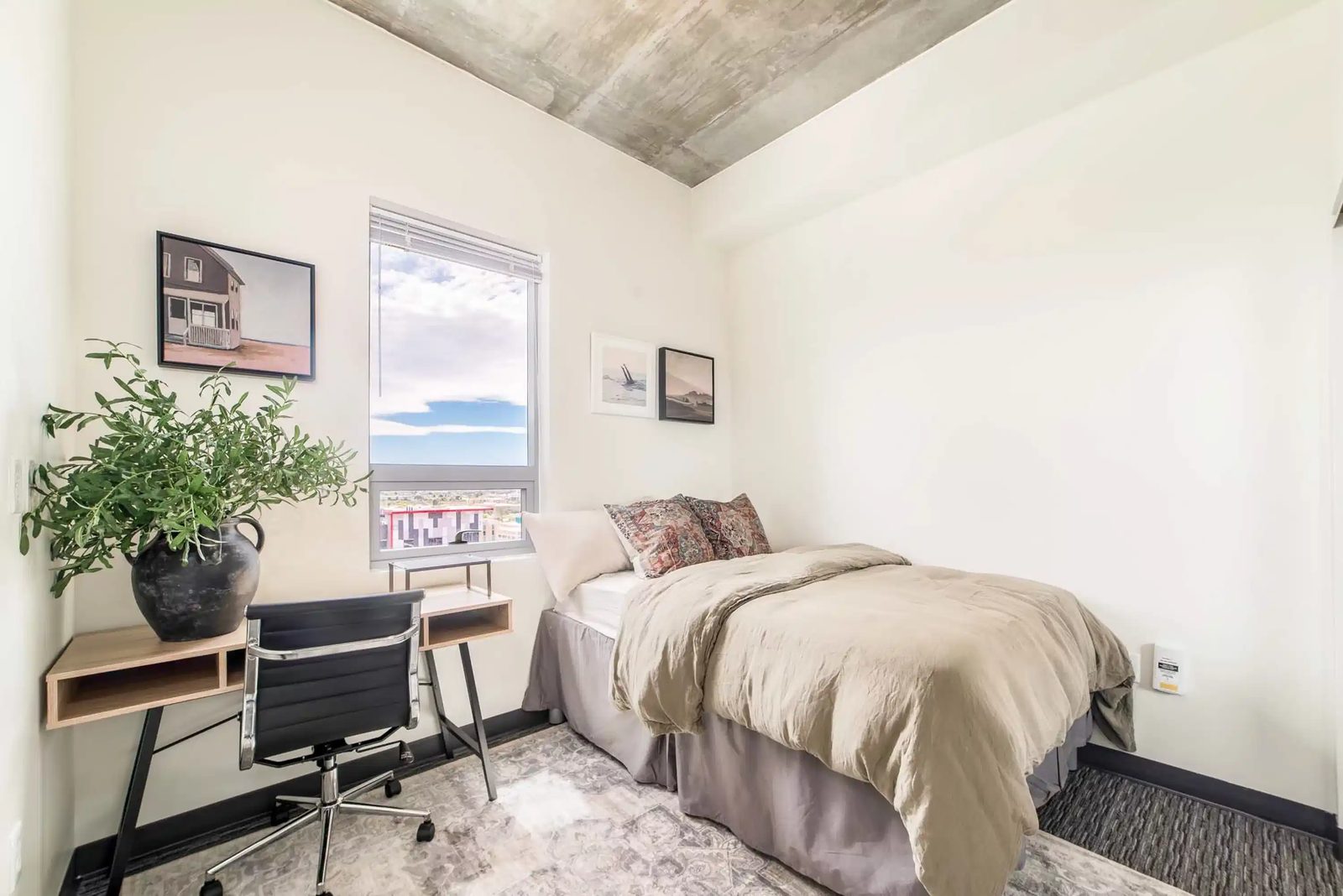
Using the available reference data, the lowest listed rate for purpose-built student housing near the University of Arizona is $599 per month (indicative — confirm with the operator). That figure likely represents a shared room or a small studio in a property with multiple tenants. Across the eight sampled residences (including Malibu, Yugo Tucson Campus, The Pacific, Aspire Tucson, Ari on Four, and others), prices climb to around $1,200–$1,500 per month for private studios or one-bedroom units with premium amenities.
A practical way to think about budgets:
- Under $700 per month – Usually a shared bedroom or a space in a cluster-style apartment (4–6 bedrooms, shared living/kitchen). This is the most common entry-level price for first-year or budget-conscious students. Expect basic furnishings, community laundry, and a location that may be a 10–15 minute walk or a short bus ride from the heart of campus. Examples in the reference list: Aspire Tucson (starting near the lower end) and Yugo Tucson Campus (often offers shared rooms near $600–$700 indicative).
- $700–$1,000 per month – A private bedroom in a shared apartment (2–4 bedrooms) or a small studio. At this level, you typically get a private bathroom, more living space, and access to a gym, pool, or study lounge. Properties like Malibu and The Pacific fall into this band for their mid-tier floor plans. Walkability improves—many are within a 5–10 minute walk to academic buildings.
- $1,000–$1,500 per month – A true studio or one-bedroom apartment. These are often in newer, amenity-rich buildings like Ari on Four (located on Fourth Avenue) or premium units at other properties. They include in-unit washer/dryer, full kitchen, and higher-end finishes. The trade-off is a larger personal footprint for a higher rent—typical for upperclassmen or graduate students who value privacy.
All prices are indicative and should be confirmed directly with each operator, as rates change by lease term and availability. Also note that some properties charge separate utility fees or parking costs (often $50–$100 per month) that are not included in the base rent.
Walk vs Transit Trade-Off
The University of Arizona campus spans about 380 acres, with most academic buildings concentrated between Speedway Boulevard to the north and Sixth Street to the south. Housing that fronts on University Boulevard or within two to three blocks of the main library (north of the university) is ideal for walkers.
Walking is feasible and pleasant for up to about a mile in mild weather (November–March). The average block in Tucson is roughly 150–200 meters, so a half-mile walk takes roughly 10 minutes. Buildings like The Pacific and Yugo Tucson Campus are located within a 5–10 minute walk from the heart of campus (near the Student Union Memorial Center). Malibu and Ari on Four are slightly farther but still within 15 minutes on foot. For warm months (April–October), the walk can be uncomfortable by the time you reach 10–15 minutes, especially at midday. Shade from mature trees, as noted in reviews, helps, but many students will still want to minimize exposure.
Transit offsets the heat. The university operates the CatTran shuttle, which has several routes looping campus and nearby streets. Routes like the “East/West Loop” and “North/Northeast Loop” serve areas along Speedway, Mountain Avenue, and around the main campus. Rides are free with a valid CatCard. Sun Tran buses (city system) also run along Speedway, Park Avenue, and other major corridors, with a semester pass costing around $150–200 (discounted for students). Many of the sampled residences are on or near a CatTran or Sun Tran stop—Aspire Tucson and Malibu are within a block of a shuttle stop.
Trade-off: Living within a 0.5-mile walk gives you maximum flexibility; you can walk in cool weather and use transit only when needed. Living 1 mile or more out (like some rooms at Ari on Four, which is closer to downtown Tucson) makes transit almost necessary in summer, but the rent may be lower or the unit larger. A bike can also be a good middle ground—Tucson is flat on the university district, and bike racks are plentiful.
Shortlisting Logic: Nearby Residences to Consider
The eight sampled residences offer a range of price points, distances, and amenity levels. Here is a practical lens for shortlisting based on what campus review themes and budget data suggest.
If walkability is your top priority – Look at Yugo Tucson Campus and The Pacific. Both are located within a few blocks of the main campus boundaries. Yugo Tucson Campus (formerly known as The University Apartments) has a mix of shared and private rooms, with starting rates near $599 indicative. The Pacific is slightly more upscale, with larger common areas and a pool. These properties let you roll out of bed and be at your first class in under 10 minutes.
If you prefer a quieter residential setting – Aspire Tucson and Malibu are set back from the busiest commercial strips, often with more outdoor space and a lower noise level. They are still within a 10-minute walk or a short shuttle ride. Aspire Tucson in particular often includes utilities in the rent, which can help budget predictability.
If you want a vibrant nightlife and restaurant scene – Ari on Four is located on Fourth Avenue, a popular entertainment district with bars, cafes, and indie shops. It is about a mile from the main campus—a 20-minute walk or a quick CatTran ride. This trade-off gives you more social options off campus, but you will need a transit plan.
If you are on the tightest budget – Look for shared rooms at Yugo Tucson Campus or Aspire Tucson. The $599 indicative rate is among the lowest for purpose-built student housing in Tucson. Confirm whether that price includes utilities and internet (many properties bundle them). Also check lease lengths: some 12-month leases may have discounts for early signing.
Consider the lease terms and room types carefully. Each property offers multiple floor plans; a “private room in a 4-bedroom apartment” can vary significantly in total cost when utilities and parking are added. Verify parking availability—some residences include a spot, others charge $50–$100 per month extra. Also check if the CatTran stop is currently active (routes have changed occasionally) and if a bike storage area is provided.
FAQ
1. What is the average rent near the University of Arizona?
For shared rooms in purpose-built student housing, indicative rates start around $599 per month. Private rooms or studios typically range from $800 to $1,300 per month, depending on amenities and proximity to campus. All figures are indicative — confirm with the operator for current availability and any promotional rates. Keep in mind that utilities (electricity, water, internet) may be separate and can add $100–150 per month during summer cooling season.
2. Which areas are within walking distance to the university?
Most student residences within a 0.5-mile radius of the main campus (bounded roughly by Speedway Boulevard to the north, Sixth Street to the south, Park Avenue to the west, and Campbell Avenue to the east) are comfortable walking distance. Properties like Yugo Tucson Campus and The Pacific fall into this zone. A 1-mile walk to the center of campus is still doable but can be hot for half the year. Neighborhoods such as Sam Hughes (south of campus) and the area around Mountain Avenue and Euclid Avenue are also popular walking options.
3. Is public transit reliable for commuting?
Yes. The university’s CatTran shuttle is free for students and runs frequently during peak hours (every 5–10 minutes) on several routes. Sun Tran city buses also serve the campus area and are reliable, though they run less frequently in evenings and weekends. A semester pass costs around $150–200 for students. Many of the referenced residences (e.g., Aspire Tucson, Malibu) are on or near CatTran routes, making transit a practical option for the summer months. Biking is another popular alternative—campus is flat and bike-friendly.
Data as of 2026. All rental prices are indicative — confirm with the operator.
Explore more: Browse all student housing guides