Housing Near the University of Salamanca: A Practical Guide
The University of Salamanca (QS World Ranking 526) is not only Spain’s oldest university (founded 1218) but also a magnet for international students drawn to its historic halls and vibrant student life. Located in the compact city of Salamanca, about 200 kilometres west of Madrid, the university’s main campus sits in the city centre, around the Patio de Escuelas. For students planning to move here for the 2026/27 academic year, choosing accommodation requires balancing budget, commute, and the experience of living in a UNESCO-listed city. Below is a data‑driven overview of what the campus reviews reveal, the local housing landscape, and how to shortlist residences using the options available near the university.
What Campus Reviews Reveal
Student reviews on the university’s Google profile (4.5 stars from 1,735 reviews) paint a nuanced picture. Some praise the historic atmosphere; others point to administrative friction.
Vlad Tomescu (rating 4) wrote:
“Great history, as it is one of the oldest Universities in Europe. But not really that much to see inside for that ticket price. Most interesting part was to me an old classroom, with centuries old banks and desks. Spoiler alert: the frog is outside. 😛”
This highlights a common travel‑guide sentiment – the building itself is a tourist draw, but daily users (students) may find the interiors modest. For those living nearby, the library and study spaces remain functional, though the “frog” (a famous carving on the facade) is a free street‑side attraction.
Sophia Borovkova (rating 1) gave a stark administrative warning:
“I love Salamanca so much but this university is giving so much struggle just to sign up for the courses. I’ve been talking to the school through EMAIL (not even WhatsApp for English inquiries) since November and still haven’t gotten to the payment yet. They respond once in blue moon and send you wro” (text truncated in original).
This suggests that incoming international students should expect slow email‑based enrollment processes – and that securing housing early (before course registration begins) can reduce stress, since a local address may be required for paperwork.
Kiana Sanajou (rating 5) offered a glowing counterpoint:
“Salamanca University is a treasure trove of history and academia. The ancient lecture halls and ornate architecture transport you to another era. Walking through its historic corridors, I couldn’t help but feel a sense of scholarly inspiration. The charming courtyards and vibrant student life added …”
Seokjin Ham (rating 5) added historical context:
“Founded in 1218 by King Alfonso IX of León, the university is the oldest university in Spain and one of the most prestigious higher education institutions in Europe. Since the Middle Ages, it has been a center of knowledge and intellectual development, gaining particular renown in the fields of theo”
The takeaway: the university delivers a memorable academic environment, but practical hurdles (administration, ticket‑price for visitors) are real. Choosing housing that minimises extra hurdles – such as commuting time and language barriers in rental contracts – can make the first semester smoother.
City Context: Salamanca as a Student City
Salamanca’s old town is walkable, safe, and dominated by two universities (University of Salamanca and Pontifical University of Salamanca). The student population (around 30,000) gives the city a youthful energy, with many bars, cafés, and plazas (Plaza Mayor is a central meeting point). Public transport is limited to a few bus lines; most students walk or cycle. The climate is continental: hot summers (30–35 °C) and cold winters (0–10 °C), so proximity to campus matters when temperatures drop.
Housing options near the university fall into three broad bands (prices are for the 2026/27 academic year and are indicative — confirm with the operator):
- Budget‑conscious (€350–€450 per month): Shared flats (pisos compartidos) in the old town or adjacent neighbourhoods. These often have older furnishings but are within a 10‑minute walk of the Patio de Escuelas. Deposit typically equals one month’s rent. Contracts are usually direct with private landlords; Spanish language skills help.
- Mid‑range (€426–€550 per month): Purpose‑built student residences (colegios mayores or private halls) that include utilities, internet, and sometimes meals. The four residences listed below start from €426 (indicative). They offer contracts in English, organised social activities, and maintenance support – ideal for first‑year international students.
- Premium (€550+ per month): Private studios or en‑suite rooms in newly built complexes on the outskirts, often with gym, pool, and shuttle buses. For 2026/27, prices may exceed €700 for a one‑bedroom apartment near the historic centre.
The given sample of four residences – Livensa Living Salamanca, Canvas Luna, Micampus Salamanca, and Amro Salamanca – represents the mid‑range segment. All are professionally managed, located within walking distance or a short bus ride from the main university buildings, and offer contracts tailored to international students.
Walk vs. Transit Trade‑Off
Because the university’s main buildings (Faculty of Philology, Law, etc.) are clustered in the historical core, living within a 15‑minute walk is practical and common. The trade‑offs are:
- Walking distance (0–1 km): Rent is higher due to location (€450–€600+), but you save on transport costs and can easily pop home between classes. Noise from nightlife can be a downside near Plaza Mayor. Residences like Canvas Luna and Amro Salamanca are typically within this radius.
- Cycling / short bus (2–3 km): Residences such as Micampus Salamanca and Livensa Living Salamanca may be located slightly outside the ring road (near the railway station or the hospital area). A bus pass costs about €0.80 per ride or €35/month. You gain quieter surroundings, larger rooms, and often lower rent (around €400–€480). The trade‑off is a 20‑ to 30‑minute commute (walk + bus) and less spontaneity for late‑night study sessions.
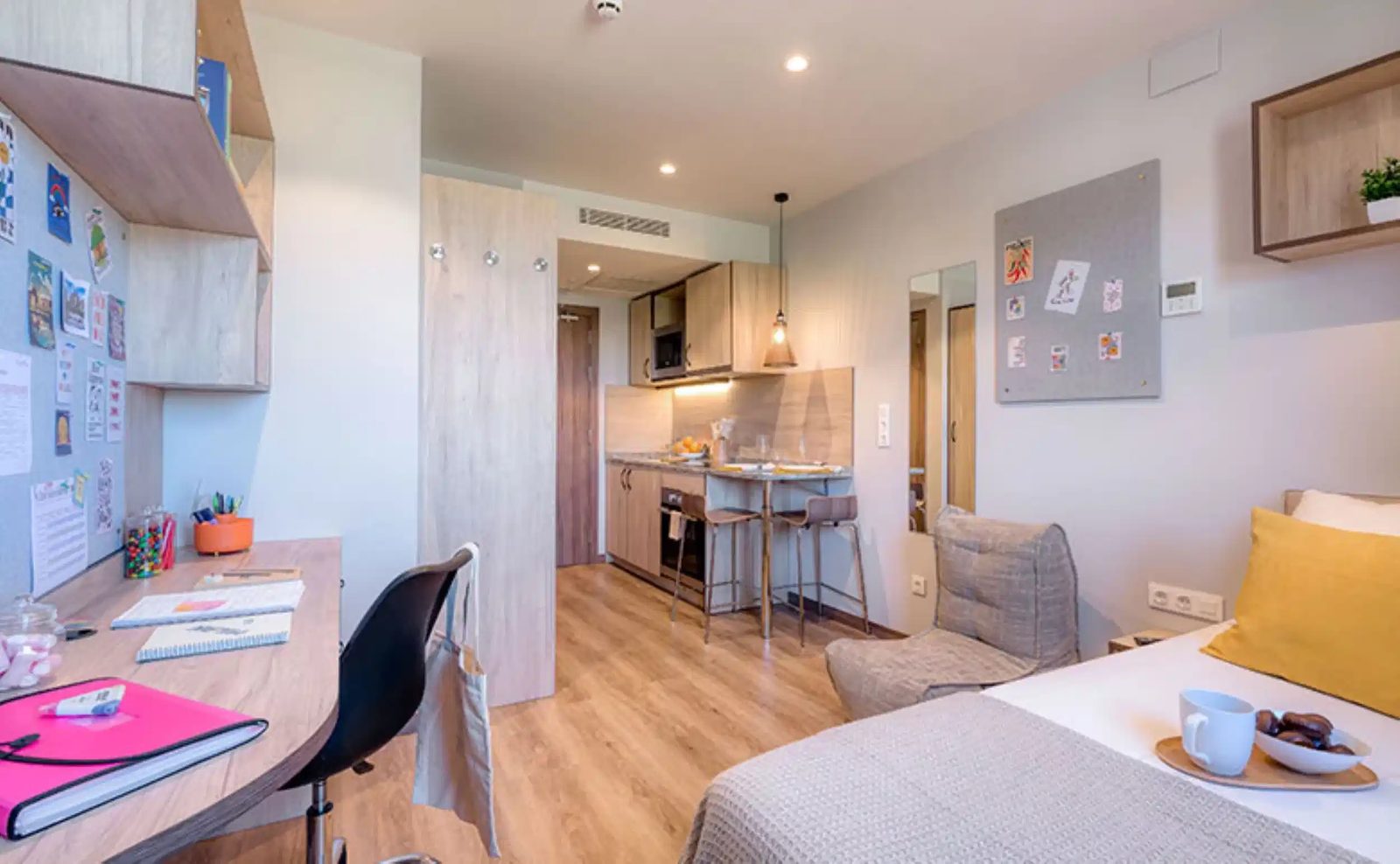
For students who rely on public transport, Salamanca’s bus network (routes 1, 2, 3, 4, 5, 6, 7, 8, 9, 11, 12) covers most residential areas. The city is also bike‑friendly; a second‑hand bicycle can cost €100–€150. No metro exists.
Shortlist Logic Using the Given Residences
When evaluating the four sample options, consider the following criteria (no single “best” exists – pick based on your priorities):
- Livensa Living Salamanca
A modern residence offering studios and shared apartments. Usually includes bills, Wi‑Fi, and access to common areas (study rooms, gym). Location: near the bus station, about 1.5 km from the university (20‑minute walk or 10‑minute bus). Suitable for students who value amenities over absolute proximity. Price indicator: from €426 per month (indicative — confirm with the operator). - Canvas Luna
A newer hall located on Avenida Portugal, roughly 1 km from the Patio de Escuelas (12‑minute walk). It offers en‑suite rooms with shared kitchen‑living, plus a courtyard. Good choice for those who want a short commute but a quieter street away from the main party zone. Price indicator: similar to the mid‑range band. - Micampus Salamanca
Part of a national student‑housing operator. Typically located on the southern edge of the city (near the Hospital Universitario), about 2 km from campus – a 25‑minute walk or 10‑minute bus ride. Offers studios and 1‑bedroom apartments. Favoured by students who prioritise space, privacy, and a calm environment. Price indicator: from €426 per month. - Amro Salamanca
Situated on Calle Zamora, a main thoroughfare leading directly to the old town. Approx. 800 m from the university (10‑minute walk). It provides en‑suite rooms in shared flats, plus a communal lounge and study area. Good for internationals who want to be central without paying the highest premium. Price indicator: mid‑range.
Shortlist decision matrix (summary):
- Shortest walk: Amro Salamanca or Canvas Luna.
- Lowest price (typically): Livensa Living or Micampus.
- Amenities (gym, events): Livensa Living or Amro.
- Quietest: Micampus (outskirts).
All four are operated by recognised student‑housing providers and offer resident support in English. Always request a contract draft before paying any deposit, and ask about cancellation policies – especially if you are still waiting for your university enrolment (recall Sophia’s review about slow email responses).
Tip: Visit the property in person (or via video tour) to assess noise levels, Wi‑Fi speed, and the condition of kitchen appliances. Some residences offer short‑stay trials for the first month.
Frequently Asked Questions
1. How much does student accommodation cost near the University of Salamanca for 2026/27?
Room prices in purpose‑built residences start from around €426 per month (indicative — confirm with the operator). Shared flats in the old town can be found from €350, while private studios may exceed €600. All prices are per month, typically including utilities and internet in residences but not in private flats. Always verify the final amount in your contract.
2. Is it better to walk or use public transport to get to campus?
Walking is the most reliable option if you live within 1.5 km of the Patio de Escuelas – about 15–20 minutes. Beyond that, the city bus network is adequate, but buses can be infrequent (every 15–20 minutes on some lines). A bicycle is a good middle ground. For residents in Micampus Salamanca or Livensa Living Salamanca, a combined walk+bus commute of 20–30 minutes is typical. The walk vs. transit trade‑off mainly affects time and cost: walking is free, while a bus pass costs roughly €35/month.
3. What should I look for when choosing a residence near this university?
Check (a) the actual walking distance to your faculty (some departments, like Psychology or Sciences, are on the south campus near the stadium), (b) the contract language – ask for English if needed, (c) whether utilities and internet are included (most residences bundle them), (d) the deposit refund process, and (e) the response time of the operator (pre‑move‑in communication speed often reflects later support). Reading recent Google reviews of the residence itself (not just the university) can reveal common issues. Given the administrative delays reported at the university, sign a housing contract early – preferably before course registration – to avoid last‑minute scrambling.
Data-date: 2026
Explore more: Browse all student housing guides