Campus Reviews: What Students Notice First
Yonsei University’s campus consistently earns high marks from visitors and students. On Google, it holds a rating of 4.7 out of 5 based on 1,665 reviews. The feedback reveals a pattern: people are struck by the atmosphere, the architecture, and how the campus feels like a place where you can actually slow down.
One reviewer, nn nhna, wrote:
“There’s something effortlessly cool about Yonsei. The campus has this calm, academic vibe — wide walkways, beautiful stone buildings, and open spaces that feel peaceful yet alive. It’s the kind of place that makes you slow down naturally. The architecture is especially striking…”
Another visitor, sherly putri, highlighted the seasonal beauty:
“Very Nice Campus in Seoul! especially when autumn, the view is stunning 😍 tried the canteen too and bought some yonsei goods.”
Amyrul Fahmy noted the visual appeal:
“Visited one of top university at korea… such beauty and lovely to snap photo… if have time will come study here”
And Mark Paul added a practical observation:
“Very very very nice campus with lots of students. Mixed with historical and modern buildings. I saw the student Union Building… It is huge! Very nice place to study. Buses stop just outside uni entrance.”
These comments point to a campus that is both photogenic and functional — qualities that matter when you are deciding where to live nearby. A pleasant environment can make daily walks to class more enjoyable, but it also means that the immediate neighbourhood is likely to be in high demand.
City Context: Seoul’s Housing Landscape
Yonsei University is located at 50 Yonsei-ro, Seodaemun-gu, in the northwestern part of Seoul. The surrounding area is a mix of university life, commercial streets, and older residential blocks. The campus sits next to the lively Sinchon district, which is packed with cafes, restaurants, shops, and entertainment venues aimed at students. A short walk east brings you to Hongdae, one of Seoul’s most famous nightlife and arts hubs.
Seoul’s student housing market is diverse but competitive. The main options include:
- University dormitories: Limited capacity, usually the cheapest, but often require early application.
- One-room (studio) apartments: Small self-contained units with a kitchenette and bathroom. Common in the Sinchon, Daehyeon, and Changcheon-dong areas.
- Goshiwon (study rooms): Tiny private rooms with shared facilities. Budget-friendly but very compact.
- Share houses / co-living: Private bedroom in a larger apartment with shared kitchen and living spaces. Increasingly popular among international students.
- Officetels: Hybrid between office and apartment, often newer and more expensive.
Rents in this part of Seoul are moderate compared to central Gangnam, but still significant for a student budget. All prices listed in this guide are indicative — confirm with the operator before making any commitments.
Budget Bands for Student Housing (2027)
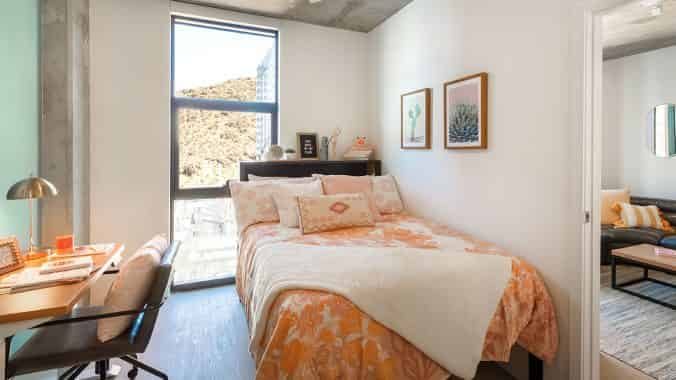
When planning your accommodation near Yonsei University, it helps to think in broad bands. Keep in mind that these figures are based on typical market observations and should always be verified with the current operator.
Band 1: Low-cost (under 350,000 KRW per month)
- Goshiwon rooms or “one-room with deposit under 5 million KRW”.
- Usually smaller, older buildings a 10- to 15-minute walk from campus.
- Shared bathrooms and kitchens are common.
- Suitable if you minimise time at home and prioritise spending on activities.
Band 2: Mid-range (350,000 – 600,000 KRW per month)
- Standard one-room apartments in older villa-style buildings.
- Deposit often between 5 and 10 million KRW.
- Typically within a 10-minute walk or a short bus ride.
- Includes basic furnishings; utilities usually separate.
Band 3: Upper-mid (600,000 – 900,000 KRW per month)
- Larger one-rooms or small officetels.
- Newer buildings with better insulation, elevator, and security.
- Often closer to the main gate or in popular areas like Sinchon-ro.
- Higher deposits (10–20 million KRW) but sometimes negotiable.
Band 4: Premium (above 900,000 KRW per month)
- Modern officetels, two-room apartments for sharing, or luxury one-rooms.
- Deposit may exceed 20 million KRW.
- Located in the most convenient spots – right next to the subway or inside the campus perimeter (rare).
- Best for those who want maximum comfort and minimal commute.
Remember: these are indicative brackets. Actual prices can vary by the season, the building’s condition, and the landlord. Always confirm the final amount and deposit terms directly with the operator.
Walk vs Transit: The Trade-Off
Yonsei University’s main campus is not huge, but the surrounding streets slope upward in some areas. Most classes are held within a 10-minute walk from the main gate. However, the student housing supply is scattered over a radius of roughly 1.5 km.
Walking only – If you choose a room within 800 metres of your department building, you can rely entirely on walking. The benefits: no monthly transit pass, no waiting for buses, and the freedom to go back to your room between classes. The catch: properties closer to campus tend to cost more per square foot, and they may be noisier due to nightlife.
Transit-assisted – If you are willing to take a bus or subway for one or two stops, you unlock cheaper options in neighbourhoods like Ahyon-dong (north of the campus) or Yeonnam-dong (west of Hongdae). The bus stop outside the university entrance, mentioned by reviewer Mark Paul, connects to several routes. Subway lines 2 (green) and 3 (orange) are within reach: Sinchon station on line 2 is a 5-minute walk from the main gate.
The trade-off is straightforward:
- Walk: convenience, time savings, but higher rent.
- Transit: lower rent, more space, but extra 10–20 minutes each way.
Most students end up living on the walking-transit border, roughly 10–15 minutes on foot from the campus. This keeps daily commutes short while still offering acceptable rent levels.
Shortlist Logic for Choosing a Residence
Because no single accommodation fits every student, a logical shortlisting process can save time and money. Use these steps to evaluate options near Yonsei University.
- Define your maximum walking distance – Decide whether you are willing to walk 5, 10, or 20 minutes. This immediately excludes half the listings and focuses your search.
- Set a realistic budget band – Include the deposit, monthly rent, and estimated utilities (typically 50,000–100,000 KRW per month). Remember that a higher deposit usually lowers the monthly rent.
- Choose a room type – If you need privacy, a one-room or officetel is better. If you don’t mind sharing common areas, a share house or goshiwan can cut costs.
- Check the landlord’s reputation – Read recent tenant reviews on platforms that allow verified feedback. Avoid any listing that does not provide clear photos or a real address.
- Visit in person or via video call – Photos can be misleading. Inspect the room’s condition, noise level, heating/cooling system, and internet stability.
- Confirm the contract details – Lease terms are typically 1 or 2 years with a break clause after 6 months. Deposit return procedures must be written in the contract. Never pay before signing.
A sample shortlist for a mid-range budget (500,000 KRW / month) might include:
- A one-room in Daehyeon-dong (8-minute walk to Sinchon station).
- A share house in Changcheon-dong (5-minute walk to the main gate).
- A studio officetel near Sinchon-ro (10-minute walk, higher deposit).
Cross-check each option against your priorities. For instance, if you value silence for studying, a room facing a main street may not suit you. If you cook often, a proper kitchen (not just a hot plate) becomes essential.
FAQ
1. When should I start looking for housing near Yonsei University?
Start your search at least 8 to 10 weeks before the semester begins. Dormitory applications usually open in January for the spring semester and in July for the fall semester. Private housing inventory becomes available 2–4 weeks before the term starts, but the best places get booked quickly. Visiting Seoul in person a week early can give you a significant advantage because many landlords prefer to show the room before signing.
2. Is it better to live in a dormitory or a private apartment near Yonsei?
That depends on your priorities. Dormitories are cheaper and come with utilities included, but space is very limited and the application is competitive. They also offer a built-in community, which helps with making friends. Private apartments give you more freedom, privacy, and often a better location if you choose carefully. However, you will need to manage your own contracts, utilities, and possibly a deposit of 5–20 million KRW. If you can afford the deposit, a private one-room near Sinchon or Daehyeon provides a good balance.
3. What is the typical deposit for a one-room near Yonsei University?
Deposits range from 5 million KRW for older, smaller units to 20 million KRW or more for modern officetels. The deposit is fully refundable at the end of the lease if there is no damage. Some landlords accept a slightly lower deposit if you pay a higher monthly rent. For international students who may not have a Korean bank account or a guarantor, it is worth checking with co-living operators that offer deposit-free options – though they usually charge a higher monthly rate. Always confirm the deposit amount and refund process in writing before paying.
Data as of 2026. Prices and availability are indicative — confirm with the operator before committing to any contract.
Explore more: Browse all student housing guides