What Campus Reviews Reveal
Dalhousie University, located at 6283 Alumni Crescent in Halifax, Nova Scotia, holds a global QS ranking of 283 and a Google rating of 4.3 from 564 reviews. The campus experience, as described by students, is mixed but leans positive. The reviews point to a university with strong academic and research foundations, but also to areas where the institution’s physical environment and student support could be improved.
Mirgani Kheir, who spent four years at Dalhousie, gave a 3‑star rating and commented: “4 years here and its not the best but not the worst, good people around that made it better but the there isnt a lot of love going into the university itself.” This suggests that while the social fabric can be rewarding, the institution’s upkeep or investment in student experience may feel lacking to some.
In contrast, Aswini A gave a 5‑star rating, describing the university as “huge, extending many acres. One can’t possibly make use of all facilities and services offered during one’s study. Students are free to follow their own world in the university. Its an all inclusive university which don’t discriminate and practices what it preaches. I am impressed.” This review highlights the breadth of resources and an inclusive environment.
Dariusz Prokopowicz, writing five months ago, gave 5 stars and called Dalhousie “the Atlantic region’s intellectual lighthouse, where a substantive legacy of ocean research and medical excellence creates a truly distinctive academic atmosphere.” This reflects the university’s reputation as a hub for marine and health sciences.
Oliver Oakly gave 4 stars, summing it up: “Pretty good university all things considered.”
Taken together, the reviews suggest that Dalhousie offers a strong academic environment with excellent research facilities, particularly in oceanography and medicine. The campus is large, inclusive, and well‑resourced, though some students feel the institution could show more “love” in terms of amenities or engagement. For a prospective student, these insights are useful when deciding how close to live to campus: those who value constant access to facilities may want a short walk or bike ride, while others comfortable with a commute might prioritize lower rent.
Halifax as a Student City
Halifax is the largest city in Atlantic Canada, with a population of about 440,000 in the metropolitan area. It is home to several universities and colleges, giving it a significant student population. The cost of living in Halifax is generally lower than in Toronto or Vancouver, but has been rising in recent years. Rent for a one‑bedroom apartment in the city centre typically ranges from CAD 1,200 to 1,800 per month, while shared accommodation can be found for CAD 700 to 1,200 per person.
Public transit is operated by Halifax Transit, with buses covering most of the city and a ferry connecting downtown Halifax to Dartmouth. The university is located in the South End neighbourhood, close to the central peninsula. Many students walk or bike to campus, but bus routes run along major streets such as South Park Street and Robie Street.
The city’s character is maritime – the harbour defines much of its identity. Students can access parks like Point Pleasant Park, the Halifax Public Gardens, and the waterfront boardwalk. Winters are cold but milder than in most of Canada, with average January highs around 0°C.
For a student planning to live near Dalhousie, the South End, West End, and central Halifax are typical choices. The university’s main campus is within walking distance of many residential streets, but housing prices vary significantly between neighbourhoods.
Budget Bands for Student Housing in Halifax
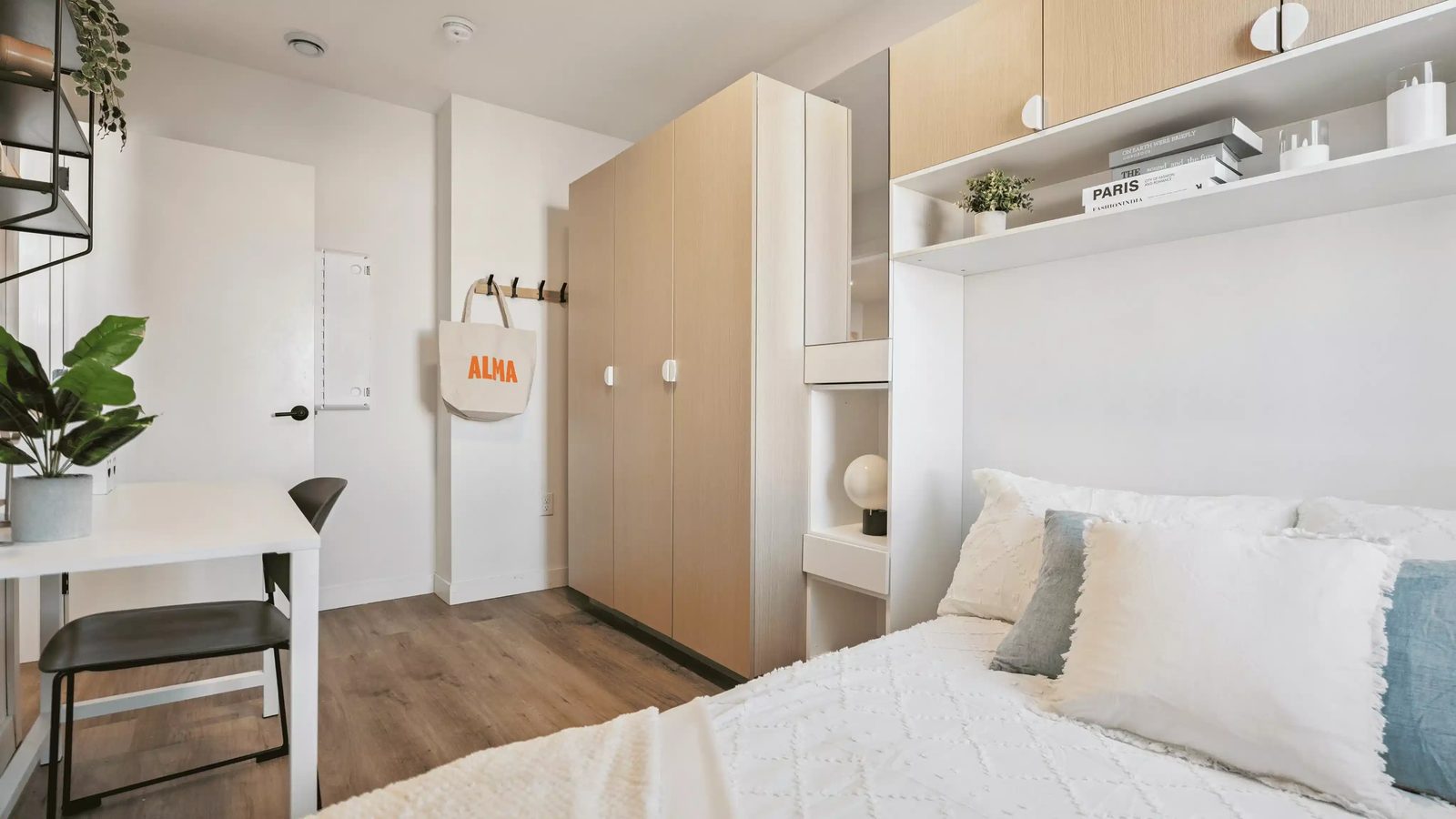
Based on current market data (indicative – confirm with the operator), student housing costs in Halifax can be grouped into three broad bands for the 2026–2027 academic year. Prices are in Canadian dollars per month and apply to shared or studio accommodations near the university.
- Budget (CAD 700–900): Typically shared rooms in older houses or basement apartments, often in the West End or North End. These may require a 20–30 minute bus ride. Furnishings may be basic.
- Mid‑range (CAD 900–1,200): Studios or one‑bedroom units, or a private room in a purpose‑built student residence. Often located in the South End or along major bus routes. Many include utilities.
- Upper (CAD 1,200–1,800+): Newer or fully renovated apartments, luxury purpose‑built residences, or units within a 10‑minute walk of campus. Often include gym, study rooms, and concierge.
The sample residence provided – ALMA @ South End – falls in the mid‑range band. Its listed price of CAD 1,170 per month (indicative – confirm with the operator) is a private room or studio in a modern building in the South End, suggesting a balance between cost and proximity.
Walk vs Transit: The Trade-Off for Dalhousie Students
Choosing between walking distance and a bus commute depends on your priorities for time, convenience, and budget. The South End, where the university is located, is compact. Most campus buildings are within a 15–20 minute walk from the South End’s residential streets. The main library, student union building, and lecture halls are concentrated around the Studley and Carleton campuses.
Walking to campus means no transit pass cost (about CAD 108 per month for a student U‑Pass), no waiting in the cold, and the ability to pop home between classes. However, rent in the immediate South End tends to be higher because of the convenience. A studio within a 10‑minute walk can easily cost CAD 1,400 or more.
Taking the bus widens your housing options significantly. Halifax Transit’s routes 1, 2, 4, 7, 9, and 10 serve the university area. A commute from the West End or North End takes 15–30 minutes one way. Monthly transit pass cost is often included in the university’s mandatory U‑Pass fee, so the marginal cost of bus commuting is low. Rent in those areas can be CAD 200–400 cheaper per month than in the South End.
For students who bike, Halifax’s modest hills and winter snow can be challenges, but many do bike from neighbourhoods like the Hydrostone or North End in warmer months.
In summary: if you value time and hate commuting, pay more for a South End unit within walking distance. If you want to save on rent and don’t mind a bus ride, look 2–3 kilometres away in the West End or North End. The sample residence ALMA @ South End is positioned as a walking‑distance option.
Shortlisting Logic: A Look at ALMA @ South End
Given the one nearby residence sample – ALMA @ South End – we can use it to illustrate the shortlisting logic a student might apply. The property is located in the South End neighbourhood, near Dalhousie’s main campus. Its listed price is CAD 1,170 per month (indicative – confirm with the operator). This price point sits in the mid‑range band, making it a practical choice for a student who wants a private room or studio without paying the highest premiums.
Why would a student shortlist ALMA @ South End? Firstly, location: the South End is the most convenient neighbourhood for a Dalhousie student. Walking to class in 5–15 minutes is realistic. Secondly, the price is competitive for a modern purpose‑built residence in that area; many older apartments in the same neighbourhood charge similar rents but may lack amenities like in‑suite laundry, gym, or study space. The “ALMA” name likely refers to a newer building developed specifically for students (the operator is not named here per guidelines). Thirdly, being a purpose‑built residence, it simplifies the search: no need to negotiate with individual landlords, and lease terms often align with the academic year.
Potential drawbacks: the South End’s amenities – grocery stores, restaurants, bars – are nearby but can be pricier than in other neighbourhoods. Noise levels may be higher because of student activity. Also, the price of CAD 1,170 does not include utilities or internet in all cases; confirm with the operator.
A student comparing ALMA @ South End to a cheaper room in the West End would weigh a 20‑minute bus ride against the convenience of walking. If the student values study time and campus access, the extra CAD 200–300 per month for the South End location may be justified. If the student is budget‑constrained, that saving could cover groceries and entertainment.
The shortlisting logic can be applied to any residence: start with budget, then prioritize location (walk vs transit), then check lease flexibility and amenities. For Dalhousie, the South End should be the first area to search if walking is a priority.
Frequently Asked Questions
1. What is the typical rent for a one‑bedroom apartment within walking distance of Dalhousie University in 2026/2027?
For the 2026–2027 academic year, a one‑bedroom apartment in the South End (within a 15‑minute walk) generally ranges from CAD 1,300 to 1,800 per month. Studio or bachelor units can be found from CAD 1,100 to 1,400. These prices are indicative – confirm with the operator or landlord. Shared accommodation in a two‑bedroom apartment typically costs CAD 700–1,000 per person per month in the same area.
2. Is living in purpose‑built student accommodation like ALMA @ South End more expensive than renting a private apartment?
Purpose‑built student residences often include utilities, internet, and sometimes a meal plan or communal events. They can be slightly more expensive per month than a comparable private apartment (where you pay utilities separately), but they offer convenience and fewer administrative hassles. For example, ALMA @ South End is listed at CAD 1,170 (indicative) for what appears to be a studio or private room. A similar private studio in the South End might cost CAD 1,200–1,400 with utilities extra. The net difference is small; the choice depends on your preference for flexibility versus an all‑in‑one solution.
3. Should I sign a 12‑month lease or a shorter term for a student residence near Dalhousie?
Most student residences near Dalhousie offer 8‑month or 12‑month leases. If you plan to stay in Halifax during the summer (for work or study), a 12‑month lease can save you the hassle of moving out and finding storage. If you leave for the summer, a shorter lease (aligned with the academic year) may be better, but such options are less common and often charge a premium per month. Always confirm lease terms with the operator – ALMA @ South End, for instance, may offer both options. For 2026–2027, many students choose a 12‑month lease because subletting to summer students in Halifax is possible, though not guaranteed.
Note: All prices mentioned are indicative for the 2026–2027 academic year and should be confirmed directly with the housing operator. No endorsement of any specific property is implied. Data‑date: 2026‑01‑15.
Explore more: Browse all student housing guides